Choosing the right toy for your child can sometimes feel overwhelming. With so many colorful, exciting, and educational toys available, parents often wonder: Which toy is best for my child’s age?
The right toy can do more than keep children entertained. Toys can encourage creativity, improve problem-solving skills, support physical development, and help children learn through play. However, children develop different skills at different ages, so choosing an age-appropriate toy is important.
In this simple guide, we’ll explore some of the best toys for kids by age, from babies to older children, so parents can make smarter and more enjoyable choices.
Why Choosing Toys According to Age Matters
Children learn and develop new abilities as they grow. A toy that is perfect for a toddler may not be challenging enough for a school-age child, while a toy designed for older children may be too complicated for a younger child.
Age-appropriate toys can help children:
- Develop motor skills
- Improve hand-eye coordination
- Encourage creativity and imagination
- Build problem-solving abilities
- Develop communication and social skills
- Explore new concepts through play
- Gain confidence and independence
When selecting toys, parents should consider the child’s age, interests, abilities, and safety rather than choosing a toy based only on its appearance.

Best Toys for Babies: 0–12 Months
During the first year, babies are constantly discovering the world around them. Toys that stimulate their senses and encourage movement are particularly useful.
Recommended Toys:
1. Soft Toys
Soft and lightweight toys can provide comfort and sensory stimulation. Choose toys that are made from baby-friendly materials and do not contain small detachable parts.
2. Rattles
Rattles can introduce babies to different sounds while encouraging them to grasp and hold objects.
3. Teething Toys
Teething toys can give babies something appropriate to chew on while helping them explore different textures.
4. Activity Mats
Activity or play mats with different textures, colors, and hanging objects can encourage babies to reach, kick, and explore.
5. Sensory Toys
Simple sensory toys with different textures, sounds, or colors can encourage early exploration.
At this stage, simple is often better. Babies don’t need complicated toys to have meaningful play experiences.
Best Toys for Toddlers: 1–2 Years
Toddlers are becoming more active and independent. They enjoy touching, moving, stacking, pushing, pulling, and exploring objects.
Recommended Toys: Best Toys for Kids by Age:
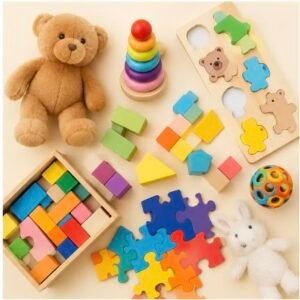
1. Building Blocks
Large building blocks allow toddlers to stack, build, and knock down structures while practicing coordination.
2. Shape Sorters
Shape-sorting toys introduce basic shapes and encourage children to think about where different pieces belong.
3. Push-and-Pull Toys
These toys encourage movement and can make active play more exciting.
4. Simple Musical Toys
Toy drums, xylophones, and other age-appropriate musical toys introduce children to sounds and rhythm.
5. Pretend-Play Toys
Simple kitchen, doctor, or household-themed toys can introduce toddlers to imaginative play.
Look for toys that are large enough to prevent choking hazards and designed specifically for toddlers.
Best Toys for Preschoolers: 3–5 Years
Between ages three and five, children develop stronger language, imagination, coordination, and problem-solving skills. This is a great age for creative and pretend play.
Recommended Toys:
1. Puzzles
Simple jigsaw puzzles help children practice concentration, matching, and problem-solving.
2. Pretend-Play Sets
Doctor kits, kitchen sets, tool sets, doll sets, and other role-play toys allow children to create their own stories and imitate everyday activities.
3. Art and Craft Toys
Coloring materials, drawing kits, modeling clay, and craft sets can encourage creativity and self-expression.
4. Construction Toys
Age-appropriate building sets can help children understand shapes, balance, patterns, and basic construction.
5. Educational Games
Matching games, alphabet games, counting toys, and memory games can make early learning more interactive.
At this age, imagination is a powerful learning tool. Let children use toys in their own creative ways rather than always showing them how to play.
Best Toys for Kids: 6–8 Years
School-age children are ready for toys that involve more complex thinking, creativity, and independent problem-solving.
Recommended Toys:
1. Advanced Puzzles
More challenging puzzles can help improve concentration, patience, and logical thinking.
2. Board Games
Age-appropriate board games can teach children about rules, strategy, turn-taking, and cooperation.
3. Science and Educational Kits
Simple science kits and educational activity sets can encourage children to ask questions and discover how things work.
4. Building Sets
Construction toys can help develop spatial awareness, creativity, and problem-solving skills.
5. Creative Kits
Craft, drawing, model-making, and DIY kits can give children opportunities to express their ideas.
Parents can also choose toys that encourage independent play while still providing opportunities for family interaction.
Best Toys for Kids: 9–12 Years
Older children often have more specific interests and are ready for toys and activities that challenge their skills.
Recommended Toys:
1. Strategy Games
Strategy-based board and card games can encourage logical thinking, planning, and decision-making.
2. STEM Toys
Science, technology, engineering, and mathematics-based toys can make learning practical and engaging.
3. Advanced Building Sets
More detailed construction sets can challenge children to follow instructions and create complex models.
4. Creative Hobby Kits
Art, craft, model-making, and other hobby kits can help children explore their interests.
5. Brain Teasers and Logic Games
These activities can encourage critical thinking and persistence.
At this age, choosing toys based on the child’s personal interests can make playtime much more engaging.
Best Toys for Teenagers: 13+ Years
As children enter their teenage years, their interests often become more specialized. Instead of traditional children’s toys, consider products and activities that support creativity, hobbies, learning, and social interaction.
Recommended Options:
- Advanced puzzles
- Strategy and board games
- Art and creative kits
- Building and model sets
- Educational STEM activities
- DIY projects
- Hobby-based games and activities
The goal is to choose something that matches the teenager’s personality, hobbies, and interests.
How to Choose the Right Toy for Your Child
Age is an excellent starting point, but it shouldn’t be the only factor. Before buying a toy, parents can ask a few simple questions:
Is it age-appropriate?
Check the recommended age range on the packaging.
Is it safe?
Avoid toys with easily detachable small parts for younger children. Also check for sharp edges, loose components, and other potential hazards.
Does it encourage learning or creativity?
Toys don’t always need to be educational, but toys that encourage thinking, creating, exploring, or problem-solving can add extra value.
Does it match my child’s interests?
A toy is more likely to be enjoyed when it connects with what the child already loves.
Can the child play independently or with others?
A balanced toy collection can include options for independent, family, and social play.
Final Thoughts
Finding the best toys for kids by age doesn’t have to be complicated. From sensory toys for babies and building blocks for toddlers to puzzles, pretend-play sets, board games, STEM activities, and creative kits for older children, every stage offers new opportunities for learning and discovery.
The best toy is often one that matches a child’s age, abilities, interests, and curiosity while providing a safe and enjoyable way to explore the world.
At Kidsplore, we believe that childhood is all about Play • Learn • Explore. With the right toys, everyday playtime can become an opportunity to imagine, create, discover, and grow.